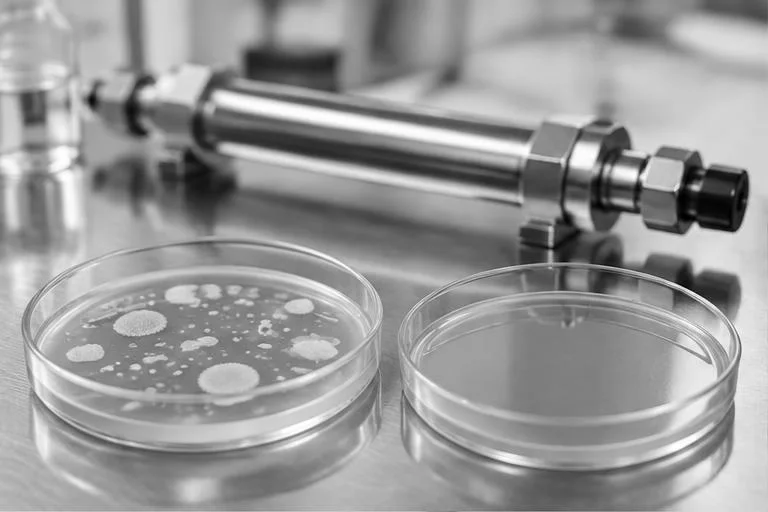
Chemical characterization asks what a material is and what else is present. A biological assay asks whether it produces a defined effect in a specified experimental system. These questions are related, but their answers are not interchangeable.
ICH Q6B treats physicochemical characterization and biological activity as separate parts of a characterization profile. Its framework concerns defined classes of biotechnological and biological products; it is useful here for interpreting evidence, not as a declaration that every research peptide falls within its regulatory scope. 1
What biological activity describes
Q6B defines biological activity through a product’s ability to achieve a defined biological effect. The definition requires an effect to be specified: “active” is not a complete scientific description.
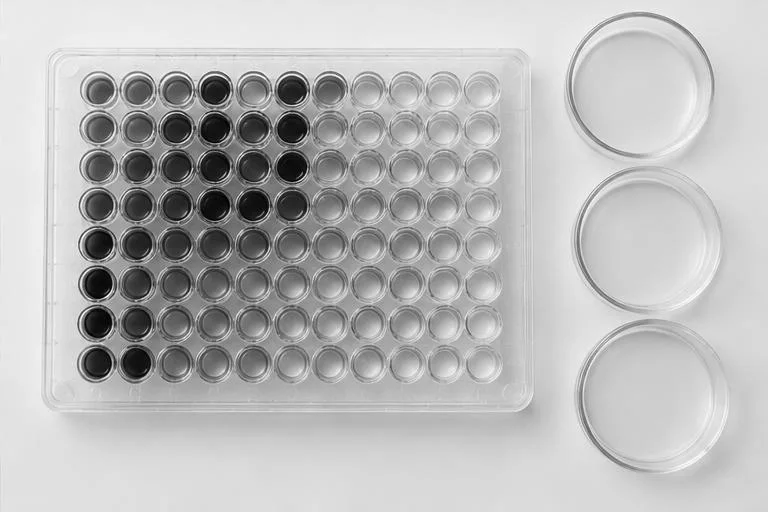
The guideline distinguishes cell-culture assays, which measure biochemical or physiological responses at the cellular level, from biochemical assays, which can measure activities such as enzymatic reaction rates. It also recognizes that ligand- and receptor-binding assays may be acceptable in appropriate circumstances. These are different forms of evidence, not interchangeable labels for one universal test. 1
A binding measurement should be read as evidence about the interaction measured, not silently converted into a claim that a downstream cellular response was demonstrated. A cellular response does not by itself supply a complete chemical characterization of the responsible material.
Potency and amount are different quantities
Q6B distinguishes potency and quantity. Potency is a quantitative measure of biological activity linked to relevant biological properties. Quantity expressed as mass is a physicochemical measurement of protein content. The guideline also distinguishes these from purity, which it describes as highly method-dependent. 1
A mass value and an activity value therefore cannot substitute for each other. A stated amount describes how much material was measured; potency describes activity within an assay’s framework. A single purity percentage does not automatically report biological activity, protein content, or every relevant structural property.
Why reference material matters
An activity result needs a comparison basis. Q6B describes calibration against an international or national reference standard when available and appropriate. Where no suitable standard exists, it describes a characterized in-house reference material and reporting activity in in-house units. 1
Two reports with numerical activity values are not necessarily comparable merely because their tables use similar terminology. Their reference materials, units and measured biological properties must be understood.
Can chemical tests replace a biological assay?
Q6B permits physicochemical tests to replace a biological assay in defined circumstances: sufficiently thorough physicochemical characterization, a demonstrated relationship to biological activity, and an established manufacturing history. 1
That is narrower than assuming chemical purity proves function. The relationship must be demonstrated for the relevant product and context, not borrowed from another molecule or inferred from a familiar name.
Where an in-vitro conclusion stops
A laboratory response is not automatically a clinical prediction. Q6B separates assay activity from expected clinical response, stating that their correlation should be established through pharmacodynamic or clinical studies. 1
The defensible conclusion is specific: the material produced the reported effect under the stated assay framework. That can be scientifically valuable without establishing human efficacy, safety, regulated-medicine equivalence, or the properties of an unrelated commercial lot.
Read the identity and purity guide for the corresponding chemical-evidence questions. The compound records connect catalog identities and available documentation without asserting biological performance.
Laboratory research use only. Not for human or veterinary use.